
Banks, swales and slopes
Erosion Control & Bank Stabilization in Sarasota, FL
Holding sand in place on pond banks, ditches and graded slopes until grass roots can take over.
- We measure the ground before we put a number on paper
- Seed mix and fertilizer timed to Sarasota County's summer rules
- Sediment barriers set before clearing near ponds, canals and swales
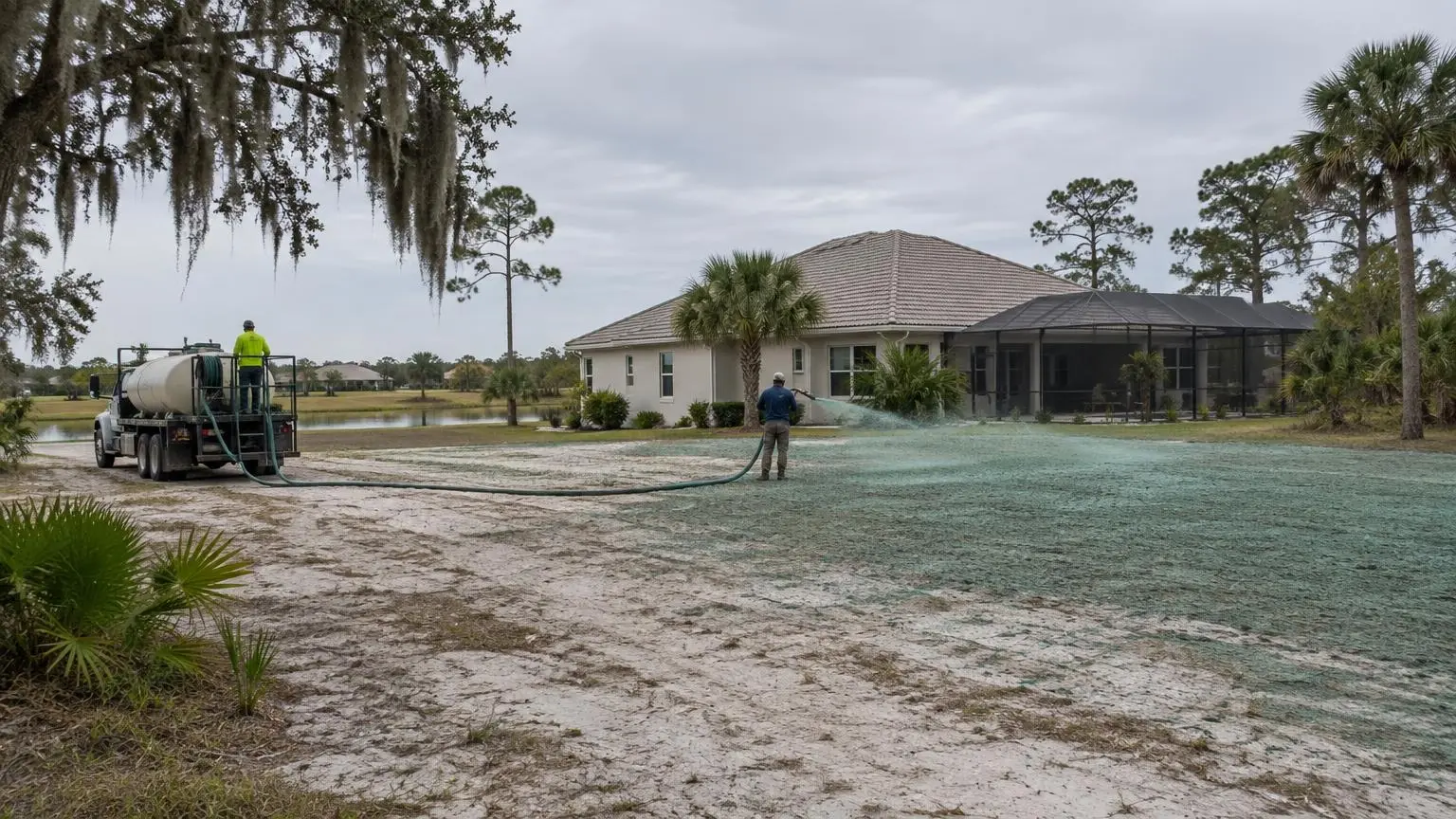
Keeping Sand Out of the Water
Erosion control and bank stabilization in Sarasota means one thing above all: keeping sand on the bank and out of the pond, canal or bay below it. The land here is flat, but it is cut through with retention ponds, drainage ditches, swales and canals, and every one of them has a graded edge. Bare sand on those edges moves easily in a summer storm. As erosion control contractors, our job is to cover that ground quickly and hold it until grass has rooted, using hydromulch, bonded fiber matrix, erosion control blankets or a mix of them.
Why flat ground still erodes
It seems odd to worry about erosion where the city's elevation is about 20 feet. But Sarasota's rain is concentrated: about 60 percent of the year's total falls from June through September, with August alone averaging 9.11 inches. Afternoon storms dump water fast, and it runs off rooftops, driveways and compacted fill toward the nearest low spot. That flow concentrates in swales and on pond banks, and loose sand with almost no clay or silt to bind it does not resist much.
Sarasota County's code sets lot side slopes at a maximum of 4 horizontal to 1 vertical and requires drainage swales to have a longitudinal slope of at least 0.2 percent. Those gentle numbers still produce long faces of bare sand on new construction, and bank faces around ponds are often steeper.
Choosing the right cover
- Hydromulch. Seed, wood fiber and tackifier sprayed together in a single slurry. It works on gentle slopes and broad areas where water sheets across rather than channels. It is the least expensive cover and goes on with the same truck as the seed.
- Bonded fiber matrix (BFM). A heavier hydraulic mulch with a stronger binder that forms a tougher, longer-lasting surface. We use it on steeper banks and in spots where a storm could come before seedlings are established.
- Erosion control blankets. Rolled mats of straw, a straw and coconut blend, or pure coir (coconut fiber), stapled over seeded ground. These are the choice in channels, at pipe outfalls, and on bank faces where water runs fast. UF/IFAS recommends that steep swales be sodded or lined with an erosion-resistant material designed for the flow, and blankets are that material.
Timing around the wet season and the fertilizer ban
The best time to stabilize a bank is before June. Ground seeded in April or May has a head start on roots when the heavy rain arrives, though it needs irrigation through the dry spring. Ground opened during the rainy season needs immediate cover, which usually means blankets or BFM instead of light hydromulch. Through the summer, Sarasota County's June 1 to September 30 ban on fertilizer containing nitrogen or phosphorus applies to bank seeding too, and with good reason: those banks drain straight into the water the ban protects. Our summer mix has no N or P.
Salt, tide and bay edges
Along tidal canals and bay edges, salt in the soil and spray limits what grows. UF/IFAS notes that St. Augustinegrass has relatively good salt tolerance, but it must be sodded or plugged, so on salt-exposed banks we often combine blankets with plugs or sod rather than seed. Where the edge is protected mangrove or wetland, we stay off it, set our controls at the upland line, and stabilize only the upland side.
What happens after installation
We check stabilized areas after heavy storms during the first season and repair rills or blanket edges that lift. Hydromulch and BFM break down as the grass grows through them. Straw blankets degrade over months and coir lasts longer, which is why coir is used where the grass will take longest to establish. Get a free estimate
Erosion Control Methods
Choosing the method depends on slope, how water moves across the area, and how soon storms are likely.
Hydromulch seeding
Seed and wood fiber mulch with tackifier for gentle slopes and broad open ground.
Bonded fiber matrix
Heavier hydraulic cover for steeper pond banks and storm-season work.
Straw erosion blankets
Short-term blanket for moderate slopes that will grass in quickly.
Straw-coconut and coir blankets
Longer-lasting blankets for channels, outfalls and steep faces.
Swale and ditch lining
Seed and blanket along drainage swales so runoff does not cut a channel.
Slope stabilization repairs
Fixing rills, washouts and undercut bank faces after storms.
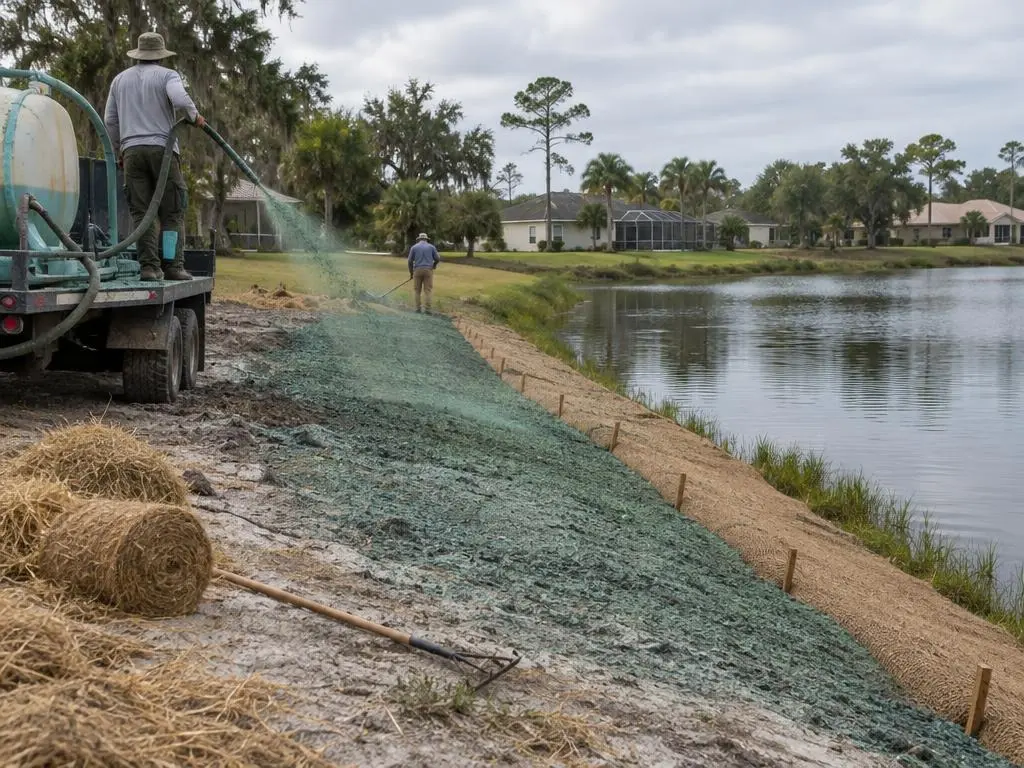
Erosion Control Cost References
| Work | Published range |
|---|---|
| Sprayed wood-fiber mulch, each 1,000 square feet (state transportation department's 2025 erosion rates) | $98 |
| 70% straw / 30% coconut mat, each 1,000 square feet (that 2025 DOT list) | $468 |
| All-coconut coir mat, each 1,000 square feet (that 2025 DOT list) | $532 |
| Steep-slope add-on for residential hydroseeding (HomeGuide) | add $0.05 to $0.10 for each sq ft |
These are published reference rates, not a quote. Slope, access and the blanket type change the total. The amount on the proposal you sign is what you pay.
How We Stabilize a Bank
1. Read the water
We look at where runoff enters, how it moves and where it has already cut.
2. Shape and smooth
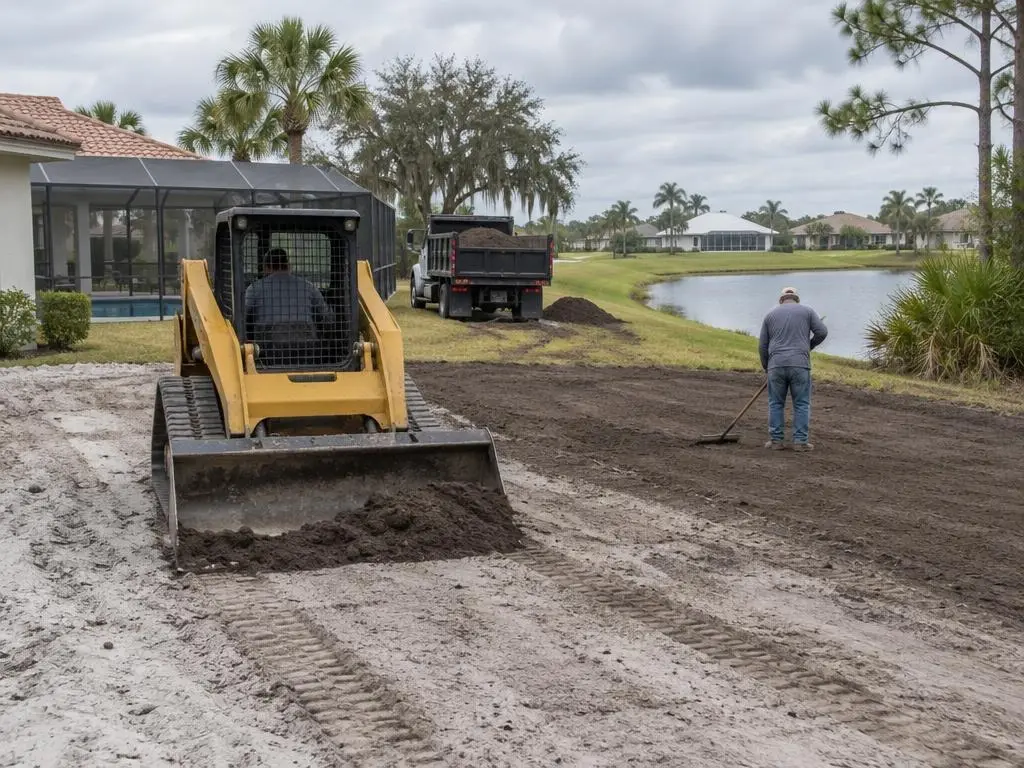
Rills are filled and the face is graded so blankets or mulch sit tight to the soil.
3. Seed and cover
Hydromulch, BFM or blankets go on, chosen for slope and flow.
4. Anchor the edges
Blanket tops are trenched in and edges stapled so water cannot get underneath.
5. Storm checks
We inspect after heavy rain in the first season and repair anything that moved.
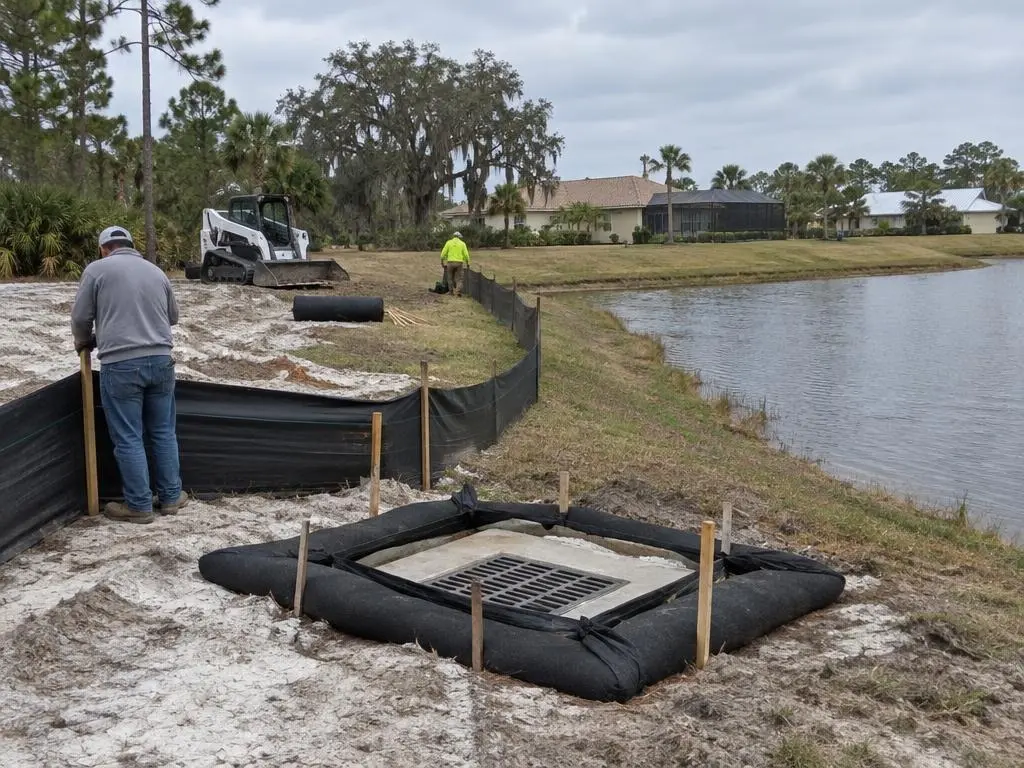
Why Choose Us for Erosion Control & Bank Stabilization
Method matched to flow
We pick mulch, BFM or blankets by how the water moves, not by habit.
Pond-safe summer mix
No nitrogen or phosphorus during the county's June-September ban.
Edges anchored properly
Most blanket failures start at an unanchored top edge, so we trench them in.
Erosion Control & Bank Stabilization Questions
Is hydromulch enough for a retention pond bank?
On gentle banks seeded outside the rainy season, often yes. On steeper faces, or when the work falls in June through September, we usually step up to bonded fiber matrix or a blanket, because a single heavy storm can move light mulch before the grass roots.
What is the difference between straw and coir blankets?
Straw blankets break down faster and suit slopes that will grass in within a season. Coir, made from coconut fiber, lasts longer and holds up better in channels and on steep faces. A straw-coconut blend sits in between.
Can you stabilize a canal bank with salt exposure?
We can stabilize the upland part of it. Salt limits what will grow from seed, and the most salt-tolerant common lawn grass here, St. Augustinegrass, has to be sodded or plugged. We often combine blankets with plugs or sod in those spots and keep off any protected wetland or mangrove edge.
How long until a stabilized bank can be left alone?
Once the grass has rooted through the mulch or blanket and covers the face evenly, which in warm months is often one growing season. We check it after heavy storms until then.
Erosion Control & Bank Stabilization Service Areas
- Hydroseeding in Sarasota, FL
- Hydroseeding in Bradenton, FL
- Hydroseeding in Lakewood Ranch, FL
- Hydroseeding in Venice, FL
- Hydroseeding in North Port, FL
- Hydroseeding in Palmetto, FL
- Hydroseeding in Port Charlotte, FL
- Hydroseeding in Punta Gorda, FL
- Hydroseeding in Englewood, FL
- Hydroseeding in Osprey, FL
- Hydroseeding in Nokomis, FL
- Hydroseeding in Parrish, FL
- Hydroseeding in Ellenton, FL
- Hydroseeding in Myakka City, FL
- Hydroseeding in Fruitville, FL
- Hydroseeding in Longboat Key, FL
- Hydroseeding in Siesta Key, FL
- Hydroseeding in Holmes Beach, FL
- Hydroseeding in Rotonda West, FL
- Hydroseeding in Babcock Ranch, FL
- Hydroseeding in Bayshore Gardens, FL
- Hydroseeding in Whitfield, FL
- Hydroseeding in Terra Ceia, FL
- Hydroseeding in Harbour Heights, FL
Get an Erosion Control & Bank Stabilization Estimate
Tell us where the water runs and we will pick the cover that holds.